英语议论文写作课件
Master the Art of Argument: A Guide to English Essay Writing 掌握论证的艺术:英语议论文写作指南**
第一部分:课程大纲
-
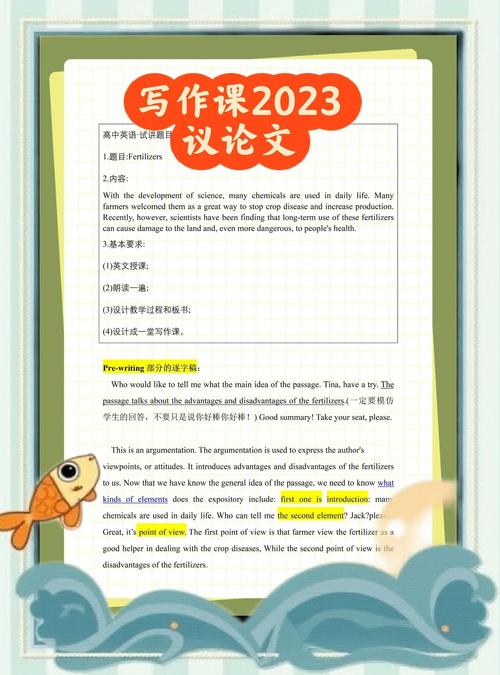
引言: 什么是议论文?
 (图片来源网络,侵删)
- 定义与目的
- 议论文的核心要素
- 议论文的重要性
-
议论文的结构:三段论式经典模型
- 引言段
- 钩子
- 背景信息
- 论点陈述
- 主体段
- 主题句
- 解释/阐述
- 论据/例子
- 分析/连接
- 小结句
- 结论段
- 重申论点
- 总结主要分论点
- 升华主题/提出展望
- 引言段
-
写作步骤:从构思到成文
- 第一步:审题与头脑风暴
- 第二步:确定论点与构建大纲
- 第三步:撰写初稿
- 第四步:修改与润色
-
主体段的艺术:如何构建有力的论证
- 分论点的选择
- 论据的类型:事实、数据、专家观点、个人经历、类比等
- 过渡词与连接词的使用
-
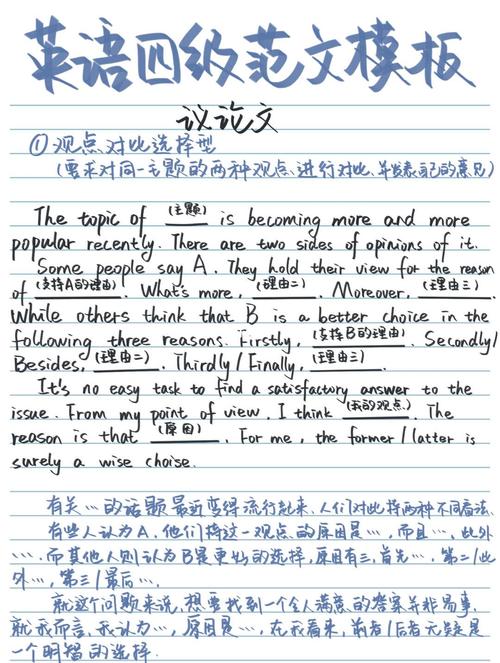
语言技巧:让你的论证更有说服力
 (图片来源网络,侵删)
- 客观、正式的语气
- 多样化的句式结构
- 精准的词汇选择
-
常见错误与避坑指南
- 逻辑谬误
- 论点不明确
- 论据不足
- 结构混乱
-
实战演练与范文分析
- 题目分析
- 范文解析
- 学生习作点评
第二部分:课件详细内容
Slide 1: 标题页
- Title: Master the Art of Argument: A Guide to English Essay Writing
- Subtitle: From Brainstorming to Polished Prose
- Image: A picture of a chessboard, a scale of justice, or a person thinking deeply.
Slide 2: 什么是议论文?
- 定义: An argumentative essay is a type of academic writing that presents a claim (a thesis statement) and provides evidence and reasoning to support that claim, while also addressing and refuting counter-arguments.
- 中文释义: 议论文是一种学术写作,它提出一个主张(即论点),并用证据和推理来支持这一主张,同时还要处理并反驳对立的观点。
- 目的:
- To persuade the reader to accept your point of view.
- To demonstrate your critical thinking and analytical skills.
- To engage in a thoughtful conversation on a topic.
- 核心要素:
- Claim (主张/论点): Your main idea or belief.
- Reasons (理由): The explanations for why your claim is true.
- Evidence (证据): The proof that supports your reasons.
- Counter-argument & Rebuttal (对立观点与反驳): Acknowledging the other side and showing why your argument is stronger.
Slide 3: 议论文的结构:三段论式经典模型
- 引言段 - The Introduction (约10%篇幅)
- Hook (钩子): Grab the reader's attention. (e.g., a surprising fact, a provocative question, a short anecdote).
- Background (背景): Provide context for the topic.
- Thesis Statement (论点陈述): Clearly state your main argument and preview your main points.
- 主体段 - The Body Paragraphs (约80%篇幅)
- Usually 2-4 paragraphs, each dedicated to a single supporting point.
- Topic Sentence (主题句): State the main idea of the paragraph.
- Explanation & Evidence (解释与证据): Explain your point and provide specific examples, facts, or data.
- Analysis (分析): Explain HOW the evidence supports your topic sentence. This is the most important part!
- Concluding Sentence (小结句): Summarize the paragraph's idea and link it to the next one.
- 结论段 - The Conclusion (约10%篇幅)
- Restate Thesis (重申论点): Rephrase your thesis statement in a new way.
- Summarize Main Points (总结分论点): Briefly remind the reader of your key arguments.
- Concluding Statement (结尾句): End with a final thought, a call to action, or a look to the future.
Slide 4: 写作步骤:从构思到成文
- Step 1: Pre-writing (写作前) - Prewrite & Brainstorm
- Analyze the Prompt (分析题目): What are you being asked to do? (e.g., "To what extent do you agree or disagree?")
- Brainstorm (头脑风暴): List all your ideas, arguments, and examples related to the topic. Don't judge them yet!
- Step 2: Outlining (构建大纲)
- Organize your brainstormed ideas into a logical structure.
- Decide on your thesis statement.
- Plan the main points for each body paragraph and the evidence you'll use.
- Example Outline:
- Thesis: Online learning offers greater flexibility and accessibility, but it lacks the crucial social interaction of traditional classrooms.
- Body 1: Flexibility - students can learn at their own pace.
- Body 2: Accessibility - breaks down geographical barriers.
- Body 3: Lack of social interaction - hinders soft skill development.
- Step 3: Drafting (撰写初稿)
- Write your essay from your outline. Don't worry about perfection; just get your ideas down.
- Focus on developing each body paragraph using the "Topic Sentence -> Explanation -> Evidence -> Analysis" structure.
- Step 4: Revising & Editing (修改与润色)
- Revising (宏观修改): Look at the big picture. Is my argument clear? Is the structure logical? Are my paragraphs well-developed?
- Editing (微观修改): Check for grammar, spelling, punctuation, and word choice errors. Read your essay aloud to catch awkward phrasing.
Slide 5: 主体段的艺术
- The "PEA" or "I.E.E." Formula:
- P (Point) / I (Idea): Topic Sentence (e.g., "One of the most significant advantages of remote work is the improvement in employee mental health.")
- E (Explanation) / E (Explanation): Elaborate on your point. What do you mean? (e.g., "Eliminating stressful commutes and allowing for a better work-life balance directly contributes to lower stress levels.")
- E (Evidence) / E (Evidence): Provide proof. (e.g., "According to a 2025 study by the American Psychological Association, remote workers reported a 25% decrease in anxiety symptoms compared to their in-office counterparts.")
- A (Analysis) / (Analysis): Analyze the evidence. Connect it back to your point. (e.g., "This data strongly suggests that the autonomy and reduced environmental pressures of working from home are key factors in fostering a healthier psychological state for employees.")
Slide 6: 语言技巧
- Formal Tone (正式语气):
- Avoid slang, contractions (don't -> do not), and overly casual language.
- Use the third person (he, she, it, they, one) instead of "I" or "you," unless the prompt specifically asks for your personal opinion.
- Varied Sentence Structure (多样的句式):
- Simple: The company profits increased.
- Compound: The company profits increased, and its stock price rose.
- Complex: Because the company invested in new technology, its profits increased significantly.
- Compound-Complex: The company invested in new technology, which increased its profits, and as a result, its stock price rose.
- Precise Vocabulary (精准词汇):
- Use strong, academic verbs (e.g., argue, assert, claim, demonstrate, illustrate, conclude).
- Use precise nouns and adjectives.
Slide 7: 常见错误与避坑指南
- Logical Fallacies (逻辑谬误):
- Ad Hominem (人身攻击): Attacking the person instead of their argument. (e.g., "You can't trust John's opinion on climate change because he's not a scientist.")
- Slippery Slope (滑坡谬误): Arguing that a small first step will inevitably lead to a chain of related events culminating in some significant impact. (e.g., "If we ban plastic bags, next they'll ban all packaging, and then the economy will collapse.")
- Straw Man (稻草人谬误): Misrepresenting or exaggerating someone's argument to make it easier to attack.
- 其他常见错误:
- Thesis is a statement of fact, not an argument. (e.g., Bad: "Social media is popular." Good: "Social media has a predominantly negative impact on adolescent mental health.")
- "Dropped" quotes. Never just insert a quote without introducing it or explaining it.
- Lack of analysis. Presenting evidence without explaining its relevance is a common mistake. The analysis is where you show your thinking.
Slide 8: 实战演练
- Essay Topic: "Some people believe that university education should be free for everyone. To what extent do you agree or disagree?"
- Task:
- Brainstorm for 5 minutes. List arguments for and against free university education.
- Formulate a thesis statement.
- Outline two body paragraphs: one supporting your thesis and one addressing a counter-argument.
Slide 9: 范文分析
- Title: The Double-Edged Sword of Free University Education
- Thesis: While making university education free could enhance social mobility and individual opportunity, the potential strain on public finances and the risk of devaluing academic degrees make it a policy that requires careful implementation, if adopted at all.
- Body Paragraph 1 (Supporting Point):
- Topic Sentence: The most compelling argument for free university education is its potential to democratize access to higher learning.
- Explanation & Evidence: Financial barriers currently prevent many talented individuals from low-income backgrounds from pursuing a degree. For instance, in countries like Germany, where public universities are tuition-free, there has been a documented increase in the enrollment of students from underrepresented socio-economic groups.
- Analysis: This demonstrates that removing the financial obstacle allows merit, rather than wealth, to become the primary factor in university admissions, fostering a more just and equitable society.
- Body Paragraph 2 (Counter-argument & Rebuttal):
- Topic Sentence: However, a primary concern is the immense financial burden this policy would place on the state.
- Explanation: Higher education is incredibly expensive to fund, covering faculty salaries, facilities, and resources. Shifting this entire cost to taxpayers could lead to higher taxes or reduced funding for other essential public services like healthcare and infrastructure.
- Rebuttal: Proponents might argue that a more educated populace leads to higher economic growth, which would eventually offset these costs. While true in the long run, this transition period could be economically unstable for governments, making it a risky proposition without a robust funding model.
Slide 10: 总结与Q&A
- Key Takeaways:
- A strong essay has a clear structure (Intro-Body-Conclusion).
- Your thesis is the backbone of your entire essay.
- Body paragraphs must be built on a foundation of Point, Explanation, and Evidence.
- Always analyze your evidence; don't just present it.
- Acknowledge the counter-argument to strengthen your own position.
- Q&A
第三部分:教学建议
- 互动性: 在讲解每个概念时,都让学生进行简短的练习,在讲“钩子”时,让他们为同一个题目想出3个不同类型的钩子。
- 小组合作: 让学生分组进行头脑风暴和构建大纲,然后互相评价。
- 同伴互评: 组织学生交换初稿,并根据一个评分清单进行互评,这能让他们从读者的角度发现问题。
- 循序渐进: 先从单个段落(特别是主体段)的写作开始,再过渡到完整的文章写作。
- 提供反馈: 对学生的习作提供具体、建设性的反馈,而不仅仅是打分,指出他们的优点和可以改进的地方。