要写出一篇英语高分议论文,需在结构清晰、论证严谨、语言精准、逻辑连贯四个核心维度下功夫,高分作文不仅需要观点明确,还需通过多样的论证手法、丰富的词汇和复杂的句式展现语言能力,同时结合具体案例增强说服力,以下从写作框架、论证技巧、语言提升及实例分析四方面展开,并附FAQs解答。
高分议论文的核心结构与内容布局
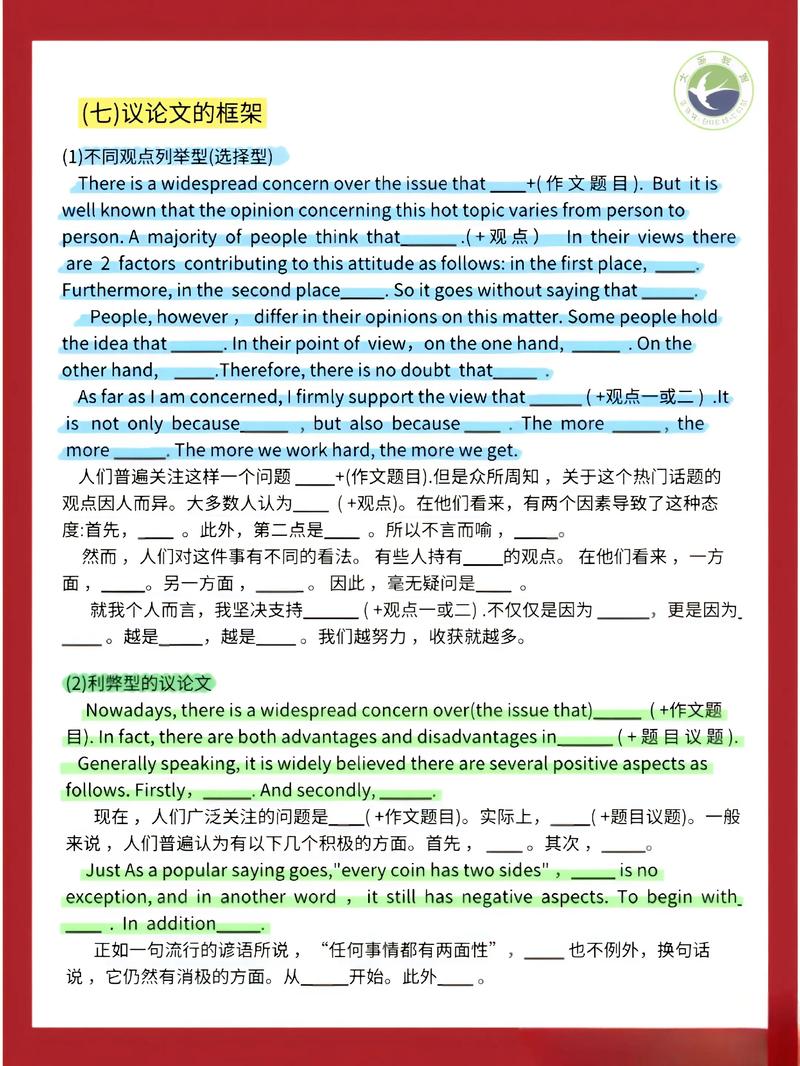
英语议论文通常采用“引言(Introduction)- 主体段(Body Paragraphs)- Conclusion)”的经典结构,各部分需明确功能、层层递进。
引言段:精准破题,亮明观点
引言段需完成背景铺垫+问题提出+ thesis statement(中心论点)三步,篇幅约占全文15%。
- 背景铺垫:用概括性语言引入话题,避免细节,例如讨论“线上教育利弊”时,可先点出“技术发展重塑教育模式,线上教育成为传统课堂的补充”。
- 问题提出:点出争议或核心问题,如“线上教育的效果与公平性引发广泛讨论”。
- 中心论点:清晰表明立场,需具体、可论证,尽管线上教育提供灵活性,但其对学习效果的负面影响及加剧的教育不平等问题,使其难以完全替代传统课堂”。
高分技巧:避免模板化开头,可使用“设问”“数据引用”或“场景化描述”吸引读者。“Imagine a student in a rural area accessing lectures from Harvard—this is the promise of online education. But does this promise hold for all?”
主体段:论证充分,逻辑严密
主体段是得分关键,通常需2-3段,每段聚焦一个分论点,结构遵循**主题句(Topic Sentence)- 论据(Evidence)- 分析(Analysis)- 小结(Concluding Sentence)”的“TEAC”结构,篇幅约占全文70%。
(1)主题句:明确分论点,与中心论点直接关联
主题句需简洁有力,概括本段核心内容。
- 分论点1:“Online education undermines learning effectiveness due to reduced interaction and self-discipline challenges.”
- 分论点2:“Moreover, it exacerbates educational inequality by limiting access to underprivileged students.”
(2)论据:具体、多样,支撑分论点
论据可包括数据、案例、专家观点、个人经历等,需真实可信且与论点强相关。
- 数据论据:引用权威机构研究,如“According to a 2025 OECD report, students in full-time online scoring 15% lower in math proficiency than those in in-person classes.”
- 案例论据:用具体事例增强说服力,如“In India, a 2025 study found that 60% of students from low-income families lacked reliable internet for online learning, widening the achievement gap.”
- 专家观点:引用领域内权威言论,如“Dr. Lisa Miller, an education psychologist at Columbia University, argues that ‘face-to-face interaction is irreplaceable for developing critical thinking and emotional intelligence’.”
(3)分析:连接论据与论点,避免“论据堆砌”
高分作文的核心区别在于“分析深度”,需解释“论据如何支撑论点”,而非简单罗列事实。
“数据表明线上学习效果较差,这并非偶然,线上环境中,教师难以实时监控学生状态,而学生易受社交媒体、游戏等干扰,缺乏课堂纪律约束,自主学习能力较弱的学生(如青少年)更容易拖延,导致知识吸收效率下降,这种‘互动缺失’与‘自律挑战’的双重作用,直接削弱了线上教育的学习效果。”
(4)小结:重申分论点,过渡下一段
小结句需简洁总结本段,并为下一段铺垫。“Thus, while online education offers convenience, its inherent flaws in learning effectiveness make it a suboptimal choice for core academic development.”
结论段:升华观点,呼应开头
结论段需重申中心论点+总结分论点+提出展望或建议,篇幅约占全文15%,避免引入新论据。

- 重申中心论点:改写thesis statement,避免重复。“In conclusion, online education, despite its flexibility, fails to match traditional classroom instruction in fostering effective learning and equitable access.”
- 总结分论点:概括主体段核心论据,如“The drawbacks of reduced interaction, discipline issues, and unequal access collectively demonstrate its limitations as a primary educational model.”
- 展望或建议:提出解决方案或未来方向,如“To harness online education’s potential, policymakers must first bridge the digital divide, while educators should design hybrid models that combine online flexibility with in-person engagement.”
提升语言表达:从“正确”到“高分”
语言是议论文的“外衣”,高分作文需在词汇多样性、句式复杂性、语法准确性上超越普通作文。
词汇:精准替换,避免重复
使用“学术词汇”替代口语化表达,并通过“上下义替换”避免重复关键词。
| 基础词汇 | 高分替换 |
|----------|----------|
| important | crucial, vital, essential, pivotal |
| good | beneficial, advantageous, conducive |
| bad | detrimental, harmful, adverse |
| show | indicate, demonstrate, illustrate, reveal |
| more and more | increasing, growing, escalating |
示例:
普通:“Online education is good for flexibility.”
高分:“The flexibility of online education constitutes its primary advantage, allowing learners to schedule studies around personal commitments.”
句式:长短结合,灵活多变
避免简单句堆砌,通过“复合句、复杂句、倒装句、强调句”等展现语言能力。
- 复合句:用从句连接逻辑,如“While online education provides convenience, it cannot replicate the dynamic feedback loop of in-person discussions.”
- 复杂句:通过分词短语、介词短语简化句子,如“Covered in technical glitches, many online platforms fail to deliver seamless learning experiences.”
- 倒装句:强调观点,如“Only when the digital divide is addressed can online education truly fulfill its promise of equal opportunity.”
语法与逻辑连接:确保准确与连贯
- 语法:避免主谓不一致、时态混乱、冠词缺失等基础错误,可使用“Grammarly”等工具检查。
- 逻辑连接:用过渡词串联段落与句子,增强流畅性。
- 转折:however, nevertheless, on the contrary
- 因果:therefore, consequently, as a result
- 递进:furthermore, moreover, in addition
- 对比:in contrast, while, whereas
实战案例:以“是否应禁止一次性塑料”为例
引言段
The proliferation of single-use plastics, from bottles to bags, has become a global environmental crisis, with over 500 million tons produced annually, according to the UN Environment Programme. While these items offer convenience, their devastating impact on marine ecosystems and human health has sparked a debate: should governments ban single-use plastics? This essay argues that a ban is not only necessary but urgent, as it is the most effective way to reduce pollution, protect wildlife, and promote sustainable consumption.
主体段1
Firstly, banning single-use plastics is crucial for mitigating environmental pollution. Plastics take hundreds of years to decompose, breaking down into microplastics that contaminate soil, water, and air. A 2025 study in Nature found that humans ingest approximately 5 grams of microplastics weekly—equivalent to a credit card—through food and water. These particles have been linked to cancer, hormonal disruption, and other diseases. By banning single-use plastics, governments can drastically reduce the volume of plastic waste entering landfills and oceans. For instance, after Kenya implemented a strict ban on plastic bags in 2025, plastic pollution in its capital, Nairobi, decreased by 80% within two years. This data clearly demonstrates that legislative action can directly curb plastic pollution and safeguard public health.
主体段2
Secondly, a ban on single-use plastics is essential for protecting wildlife. Over 800 marine species are known to have ingested or been entangled in plastic waste, with sea turtles, whales, and seabirds being the most affected. In 2025, a video of a turtle with a plastic straw lodged in its nostril went viral, highlighting the brutal reality of plastic pollution. While biodegradable alternatives exist, they are often more expensive and less accessible. A ban, therefore, forces both producers and consumers to shift to sustainable alternatives, such as cloth bags or glass bottles. This transition not only saves wildlife but also encourages innovation in eco-friendly materials, creating a circular economy that reduces reliance on finite resources.
结论段
In conclusion, banning single-use plastics is a critical step toward addressing the environmental and health crises caused by plastic pollution. By reducing waste, protecting wildlife, and fostering sustainable consumption, such bans offer a tangible solution to a global problem. While some argue that bans inconvenience consumers or harm businesses, the long-term benefits—cleaner oceans, healthier populations, and a more sustainable future—far outweigh the short-term costs. Governments must act decisively, combining bans with public education and support for green industries to ensure a plastic-free world for generations to come.
相关问答FAQs
Q1: 英语议论文中,如何平衡“观点表达”与“客观论证”?
A: 高分作文需在“明确立场”与“客观分析”间找到平衡,中心论点需清晰表明个人立场(如“反对禁止一次性塑料”或“支持禁止”),避免模棱两可,主体段论证时,需优先使用“客观论据”(数据、案例、专家观点),减少主观情感表达(如“I think”“I feel”),若需反驳对立观点,可采用“让步-转折”结构(如“While opponents argue that bans will increase costs for businesses, evidence shows that long-term environmental savings outweigh short-term expenses”),既体现包容性,又强化自身观点,关键是:观点是“靶心”,论据是“箭头”,所有分析都需指向靶心,避免泛泛而谈。
Q2: 如何在议论文中有效使用“例子”,避免例子堆砌?
A: 有效使用例子需遵循“相关、具体、分析”三原则。
- 相关:例子必须直接支撑分论点,避免“张冠李戴”,论证“线上教育加剧不平等”时,应选用“低收入家庭缺乏网络”的案例,而非“线上课程内容丰富”的无关案例。
- 具体:例子需包含细节(时间、地点、数据、人物),增强真实感,与其说“有些国家禁止塑料袋”,不如说“卢旺达在2008年成为首个全面禁塑的国家,塑料污染减少90%”。
- 分析:这是关键!需解释“例子如何证明论点”,而非仅描述例子。“卢旺达的案例证明,政府禁塑不仅可行,还能显著减少污染——这正是因为其政策配套了严格的执法和公众宣传,说明单一禁令需辅以配套措施才能生效。” 通过分析,例子从“孤立事实”变为“论证链条”的一部分,避免堆砌感。