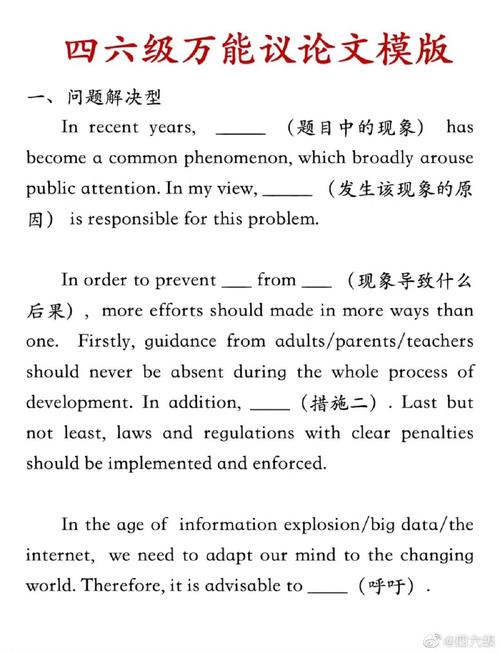
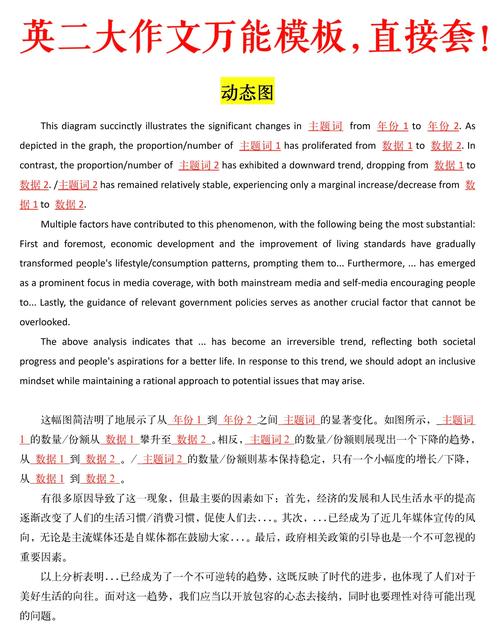
议论文英文模板是帮助结构化写作、提升逻辑性和表达效率的重要工具,尤其适用于学术写作、考试作文(如雅思、托福)等正式场景,一个优质的模板应包含引言(Introduction)、主体段落(Body Paragraphs)和结论(Conclusion)三大核心部分,同时融入论点清晰、论据充分、过渡自然等要素,以下将从模板结构、各部分功能、常用句式及注意事项展开详细说明,并结合实例说明其应用方法。
议论文英文模板的核心结构
议论文的核心目标是“提出观点—论证观点—总结观点”,模板需围绕这一逻辑链条设计,以下是标准的三段式结构扩展,可根据题目要求调整为四段式(如双面论证)。
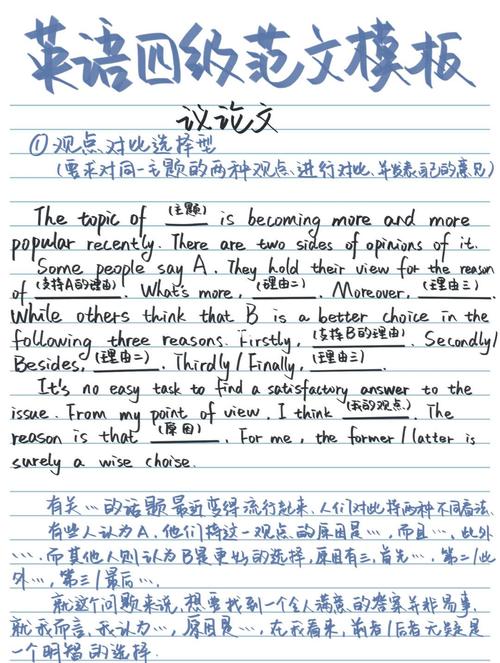
引言段(Introduction):明确主题,提出论点
功能:吸引读者、背景铺垫、明确立场、预告文章结构。
结构组成:
- 背景句(Hook):用普遍现象、数据、名言或问题引出话题,避免空泛。
例:In an era dominated by technological advancement, the debate over whether artificial intelligence will surpass human intelligence has intensified. - 主题句(Topic Sentence):简要说明讨论的核心问题,缩小范围。
例:Among various perspectives, a growing number of experts argue that AI’s capacity for data processing and learning enables it to outperform humans in specific tasks. - thesis statement(论点句):清晰表明作者立场,是全文核心。
例:This essay will argue that while AI excels in efficiency and precision, human intelligence remains irreplaceable due to its creativity, emotional depth, and ethical judgment.
主体段落(Body Paragraphs):分层论证,支撑论点
功能:通过分论点、论据和分析展开论证,每个段落聚焦一个核心论据。
标准结构(PEEL/TEAL框架):
- P/T(Point/Topic Sentence):段落主旨句,明确本段要论证的分论点。
- E(Evidence):论据,包括数据、案例、权威观点等,需真实、相关。
- E(Explanation):分析论据与分论点的逻辑关系,解释“为什么”。
- L(Link):连接下一段,或总结本段对论点的支撑作用。
示例段落(以“人类创造力不可替代”为例):
Point: One fundamental advantage of human intelligence over AI lies in its capacity for genuine creativity. Evidence: For instance, while AI can generate paintings or music by analyzing existing patterns, it cannot replicate the originality behind works like Picasso’s “Guernica” or Beethoven’s “Symphony No. 9,” which emerged from profound emotional responses to historical events. Explanation: These creations are not merely combinations of past data but reflections of human experiences, empathy, and the ability to imagine beyond existing boundaries—qualities rooted in consciousness rather than algorithmic computation. Link: Thus, creativity remains a uniquely human trait that AI cannot truly emulate.
结论段(Conclusion):总结观点,升华主题
功能:重申论点、概括分论点、提出建议或展望,避免引入新论据。
结构组成:
- 重申论点(Restate Thesis):用不同词汇复述核心观点,避免简单重复。
例:In conclusion, although AI demonstrates remarkable capabilities in data-driven tasks, human intelligence’s unique strengths in creativity, emotional understanding, and ethical reasoning ensure its irreplaceable role in society. - 总结分论点(Summarize Key Points):简要回顾主体段落的论据。
例:From the originality of artistic creation to the nuances of moral judgment, human traits transcend mechanical computation. - 升华/建议(Recommendation/Implication):提出建议、影响或未来方向。
例:Therefore, rather than viewing AI as a competitor, we should focus on fostering human-AI collaboration to maximize technological benefits while preserving our core humanity.
模板常用句式与过渡词
引言段:
- 背景引入:Nowadays..., It is widely believed that..., There is a growing concern over...
- 论点明确:This essay will argue that..., The primary issue is whether..., From my perspective...
主体段落:
- 分论点提出:Firstly, ..., Another key point is ..., Moreover, ...
- 论据支撑:A case in point is ..., According to a study by ..., For example, ...
- 分析论证:This suggests that ..., The underlying reason is ..., It is evident that ...
结论段:
- 总结观点:To sum up, ..., In essence, ..., Overall, ...
- 升华主题:Looking ahead, ..., It is crucial to ..., Only by ... can we ...
过渡词:However, Nevertheless, On the one hand, On the other hand, Consequently, As a result(确保段落间逻辑连贯)。
模板应用注意事项
- 避免模板化陷阱:模板是框架,需根据题目灵活调整内容,避免生搬硬套导致文章空洞。
- 论据的真实性与相关性:数据或案例需准确,且必须直接服务于论点,避免堆砌无关信息。
- 语言的学术性与简洁性:使用正式词汇(如 demonstrate 替代 show),避免口语化表达,同时保持句子简洁清晰。
- 逻辑严谨性:确保每个分论点与总论点直接关联,分析部分揭示“论据→论点”的因果关系。
模板应用示例(简化版) Should college education be free for all students?
论点:Free college education is beneficial for society as a whole.
引言段:
Hook: The rising cost of higher education has become a barrier to social mobility in many countries. Topic Sentence: One proposed solution is making college tuition free for all students. Thesis: This essay will argue that free college education promotes equal opportunities, enhances economic growth, and fosters a more educated society.
主体段落1(平等机会):
Point: Firstly, free college education eliminates financial barriers, enabling students from low-income backgrounds to access higher education. Evidence: In countries like Germany, where tuition is free, the enrollment rate of students from low-income families has increased by 20% over the past decade (OECD, 2025). Explanation: This reduction in inequality ensures that talent is not wasted due to economic constraints, creating a fairer society.
主体段落2(经济增长):
Point: Secondly, a more educated workforce drives economic innovation and productivity. Evidence: A report by the World Bank indicates that countries with higher tertiary education enrollment rates experience 1.5% faster annual GDP growth. Explanation: Free college education encourages more students to pursue specialized skills, meeting the demands of modern industries and boosting global competitiveness.
结论段:
Restate Thesis: In conclusion, free college education is a worthwhile investment as it promotes equality, stimulates economic development, and builds a knowledgeable society. Summary: By removing financial obstacles and enhancing human capital, nations can achieve long-term prosperity. Recommendation: Governments should prioritize funding free education to ensure a brighter future for all.
相关问答FAQs
Q1: 使用议论文英文模板会导致文章显得刻板吗?如何避免?
A1: 模板本身是结构化工具,是否刻板取决于内容填充,避免刻板化的方法包括:结合具体题目调整段落顺序(如双面论证可先让步再反驳)、使用个性化的论据(如个人经历或独特案例)、在分析部分加入深度思考(如探讨论点的隐含意义或潜在影响),模板如同建筑的“钢筋骨架”,而“血肉”需通过真实的观点和丰富的论据来填充,最终实现逻辑与内容的统一。
Q2: 如何在议论文中有效反驳对立观点?
A2: 反驳对立观点需遵循“让步-反驳”逻辑,即先承认对方论点的部分合理性(让步),再通过论据或逻辑漏洞削弱其说服力(反驳),若讨论“AI是否应取代人类工作”,可先让步:“Admittedly, AI can perform repetitive tasks with higher efficiency, reducing labor costs for companies.” 然后反驳:“However, this ignores the fact that mass unemployment due to AI replacement would lead to social instability and reduced consumer purchasing power, ultimately harming the economy.” 反驳时需使用具体数据或案例(如“a 2025 study by MIT found that AI automation could displace 20 million jobs by 2030, but creating new roles in AI management and ethics requires human expertise”),确保反驳有理有据。